Network Fiber implementation notes
Documentation index · Generation pipeline · Stage 13 convergence · v13 AAO publication
Status and scope
network-fiber is a standard, default-rendered pass (formerly “Fiber
Synthesized”). Its checked-in input lives in assets.static/fiber-synthesized,
so ordinary generation does not need network access, an external checkout,
credentials, or the optional network-topology authorization state.
The dataset is a validated cleanup and union of the TeleGeography submarine-
cable API snapshots v3.2022 and v3.20260805. It is not a strict set
difference. The unused path assets.static/fiber-evolution is reserved for a
future new - old product if one is implemented.
Published v14 previews
Network Fiber is present in every projection of the immutable v14 AAO release
(published under the former “Fiber Synthesized” product name). These dedicated
480-pixel thumbnails show the checked cleanup and union with v3.20260805 as
the primary visible snapshot. Select one to stream the corresponding layered
.svg.gz through the corrected v14 viewer.
| Cahill–Keyes | AuthaGraph |
|---|---|
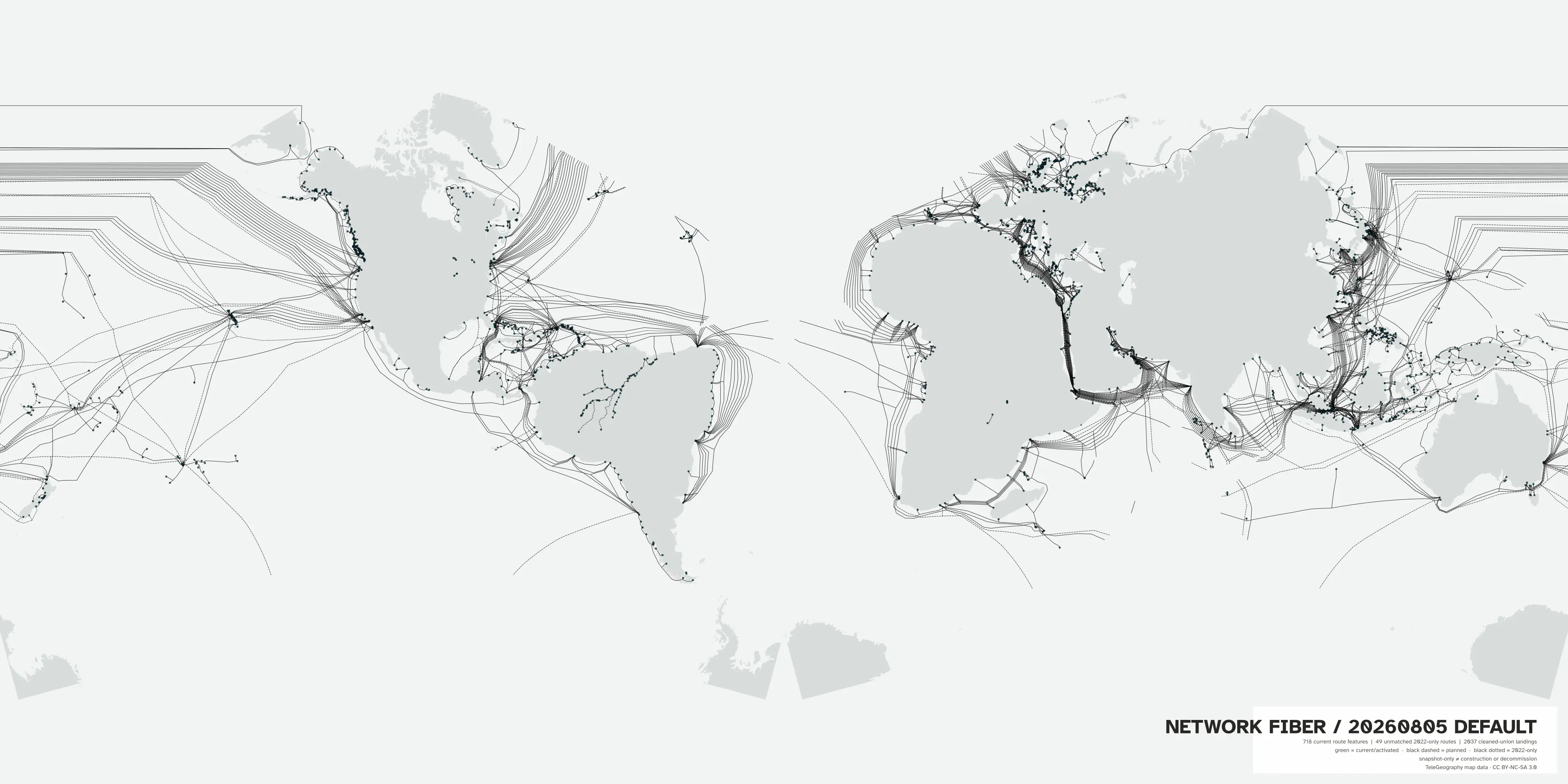
|
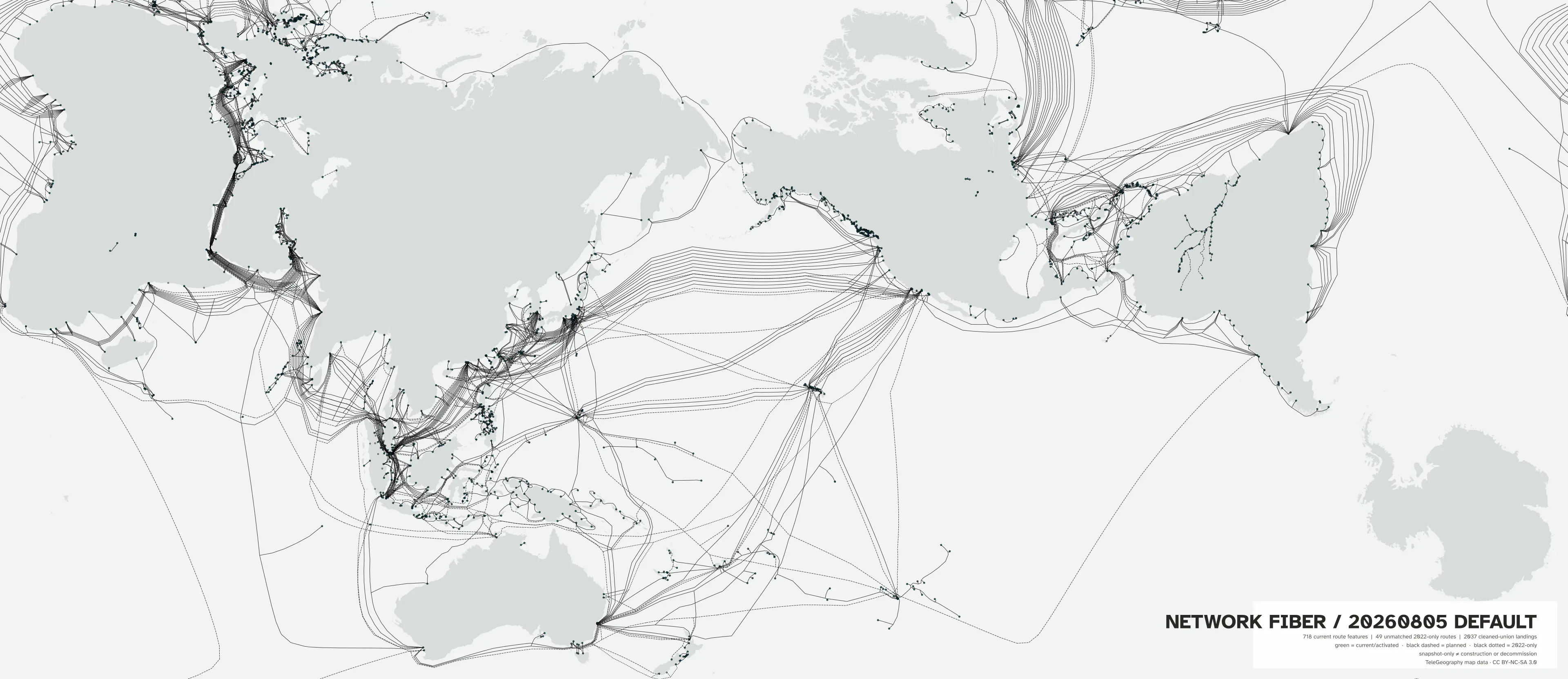
|
| Dymaxion | Myriahedral |
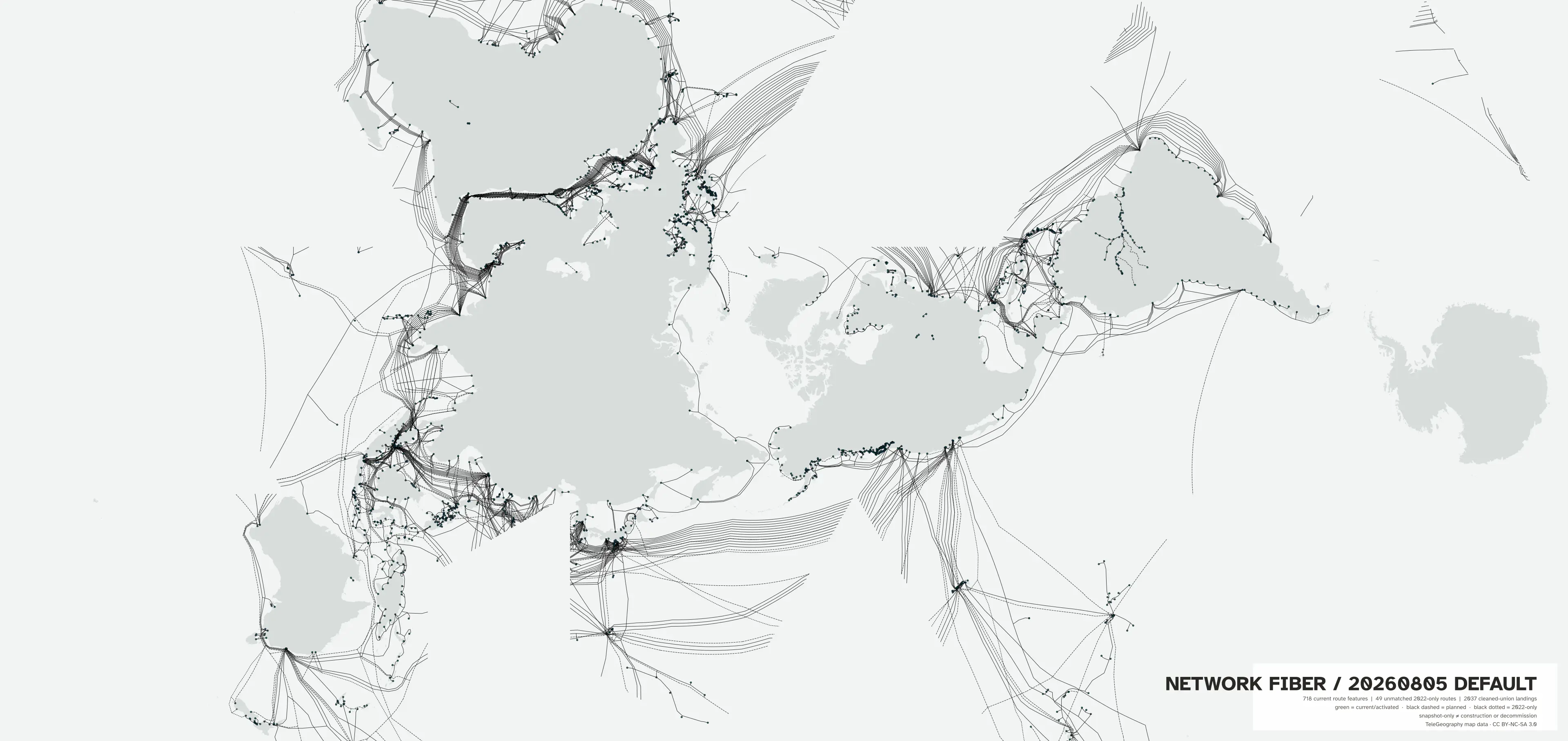
|
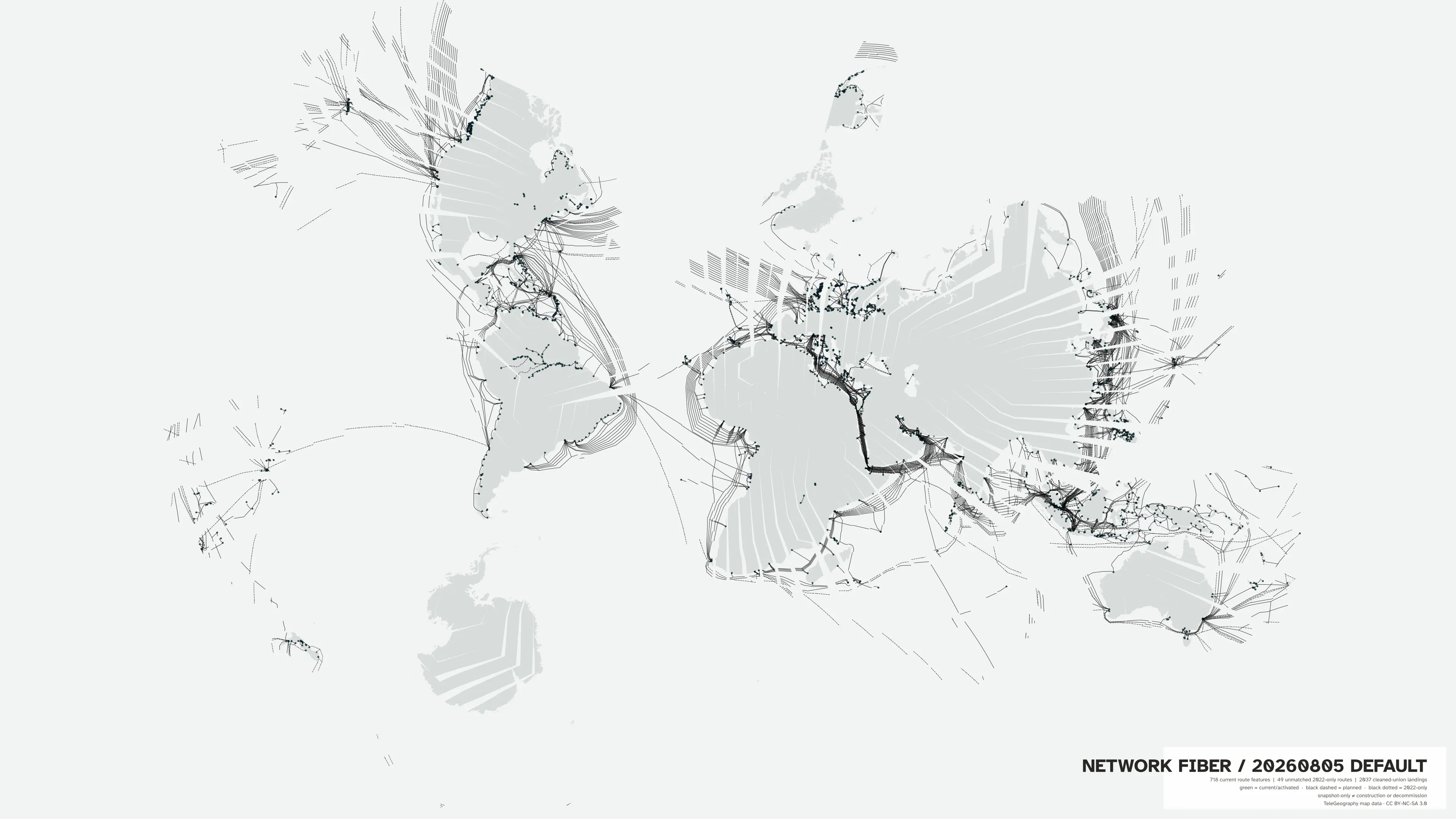
|
| Star-X | Voronoi |
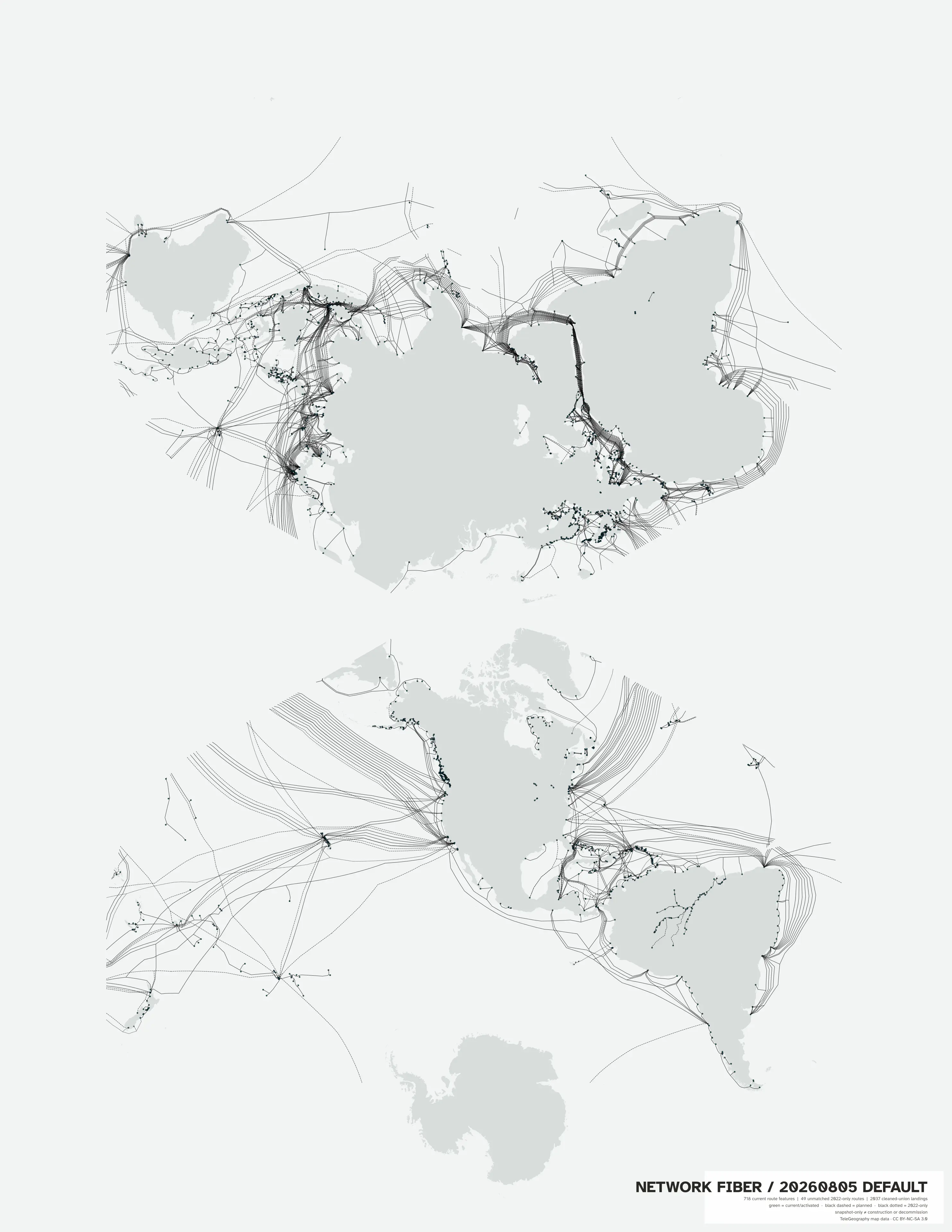
|
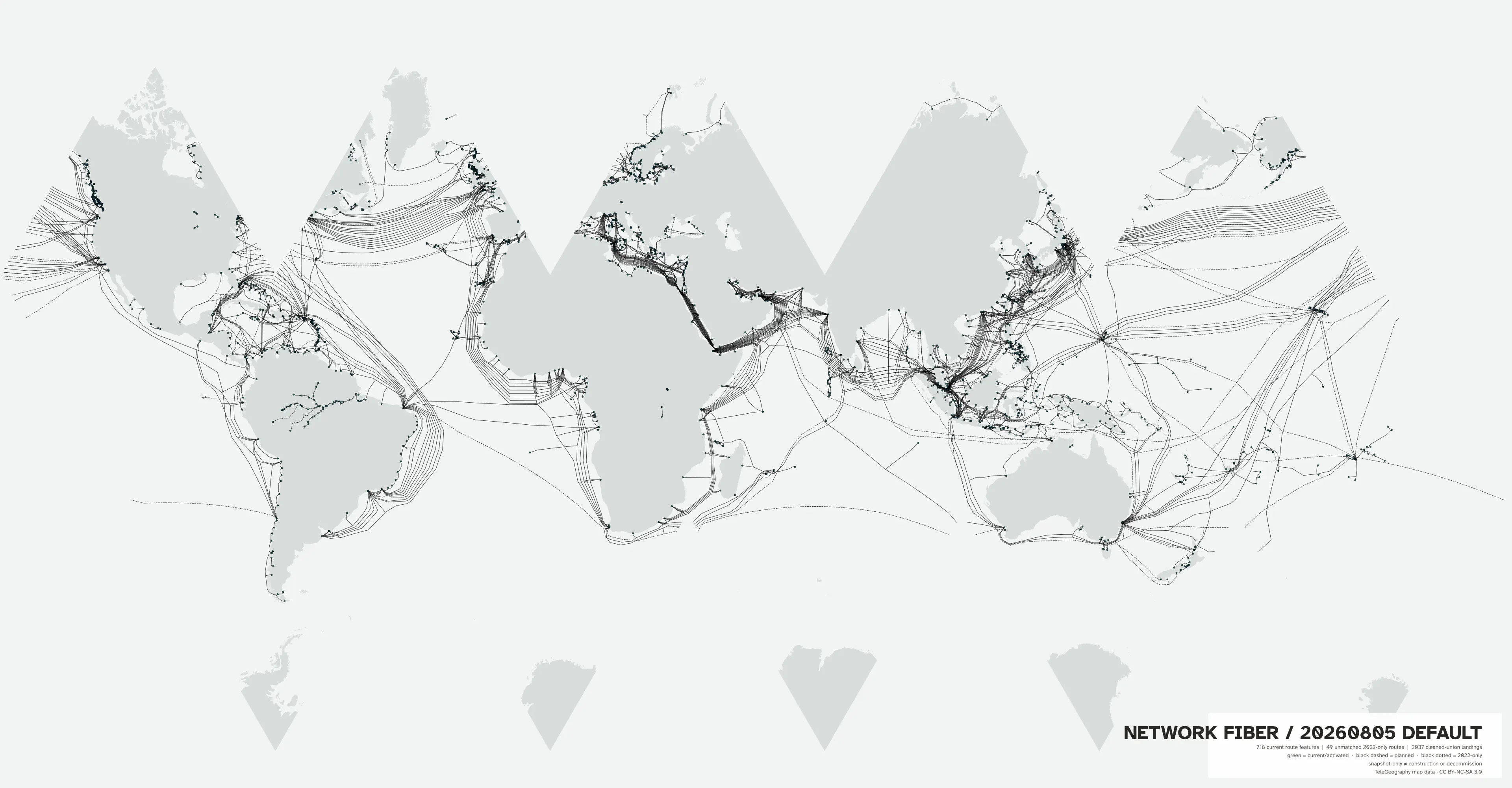
|
Source boundary
Both source directories came from checkout
4d98b5472152a7c2272c49d8d0125b1ae0419984 of
https://github.com/telegeography/www.submarinecablemap.com:
| Snapshot | Systems | Route features | Route parts | Vertices | Landings | Planned systems |
|---|---|---|---|---|---|---|
v3.2022 |
526 | 532 | 1,458 | 11,590 | 1,436 | 65 |
v3.20260805 |
697 | 718 | 1,930 | 14,075 | 1,922 | 91 |
The manifest pins the route, landing, and combined cable-detail SHA-256 digests for both snapshots. Every JSON document parses; route and landing GeoJSON types and coordinate bounds validate; cable-index IDs exactly match routed IDs; cable details match filenames; and every cable-to-landing reference resolves.
Each snapshot lacks one otherwise redundant standalone landing-detail file:
sapporo-japan.json in 2022 and cape-town-south-africa.json in 20260805.
This is recorded as benign because the aggregate landing collections are
complete, every cable reference resolves, and neither synthesis nor rendering
consumes the standalone landing-detail files.
TeleGeography map data is CC BY-NC-SA 3.0 Unported. The static dataset and generated pass retain that license and attribution boundary.
Cleanup and union algorithm
scripts/synthesize-submarine-cable-snapshots.py performs the synthesis
deterministically:
- recursively parse and validate every source JSON file;
- validate cable index, details, routes, landings, IDs, references, coordinate bounds, and source counts;
- pair system observations when they have the same safe ID, one unique exact Unicode-normalized name, or one unique exact nonempty landing-ID set across both complete snapshots whose names also share a normalized token of at least three characters; the last is recorded separately as strong topology evidence rather than an exact-name identity;
- classify exact pairs as retained active, retained planned, planned-to-active, or active-to-planned;
- retain unmatched observations with neutral
SNAPSHOT-onlylabels rather than claiming additions, removals, construction, or decommission; - preserve both source geometries in audit files without averaging, interpolation, or fuzzy identity inference; and
- build the cleaned union from every
v3.20260805feature plus only unmatchedv3.2022-onlyfeatures, preventing matched older geometry from being drawn twice.
The result contains 746 comparison identities: 456 stable-ID matches, three
unique exact normalized-name matches, 18 strong unique landing-set/name-token
matches, 49 v3.2022-only records, and 220 v3.20260805-only records. There
are 34 planned-to-active system identities. Three unique landing-set
candidates with no shared name token remain unmatched rather than risking a
false identity assertion.
The checked outputs are:
| File | Role |
|---|---|
routes.geojson |
767-feature cleaned union consumed by the renderer |
landings.geojson |
2,037-feature cleaned union consumed by the renderer |
systems.json |
identity matches, observations, change flags, and classifications |
route-observations.geojson |
all 1,250 source-separated route observations |
landing-observations.geojson |
all 3,358 source-separated landing observations |
manifest.json |
source pins, selection policy, counts, caveats, and payload hashes |
SHA256SUMS |
integrity list for every checked payload and README |
Regenerate the static snapshot explicitly with:
make refresh-network-fiber
make check-network-fiber
Refresh is intentionally not a dependency of make all: a source refresh is
a reviewable static-data change, while standard rendering remains offline.
Default rendering
The SVG group network-fiber is the default data layer. It draws all 718
route features from v3.20260805 plus 49 unmatched v3.2022-only route
features. The 20260805 snapshot is therefore the primary and complete visible
network, with older-only context kept faint and dashed. The rendering follows
the alpha60 fiber style: current and activated routes are green
(rgb(18,152,12)), while planned and 2022-only context routes are black.
| Rendering | Meaning |
|---|---|
| green solid | exactly matched, current active route |
| green solid | unmatched v3.20260805-only active route |
| green solid | current route whose exact system identity changed from planned to active |
| black dashed | current planned route |
| black dashed | unmatched v3.2022-only route; historical snapshot context only |
The plate explicitly states “snapshot-only ≠ construction or decommission.” Current landing points are filled; unmatched older landing points are hollow. All products use the Stage 13 light-gray background, enlarged route/point marks, and 2× plate title.
The same Natural Earth base and seam-safe path projection serve Cahill–Keyes, AuthaGraph, Dymaxion, Myriahedral, Star-X, and Voronoi. Star-X uses the shared fixed 60°S Antarctic cap and topmost Antarctic paint order.
Build targets and profile selectors
Generate the standard family with:
make generate-network-fiber
make generate-network-fiber-artifacts
make generate-network-fiber-cahill-keyes
network-fiber, fiber, and fiber-map are generation-profile aliases.
Because the pass is standard, its six SVG, PDF, PNG, and Cahill–Keyes snapshot
products are part of the ordinary make all graph.
Verification
tests/test-fiber-synthesized-generation.cc checks the source/default labels,
manifest counts and digests, cleaned-union classifications, and representative
geometry in all six projections. The generator reopens every SVG and checks
its viewBox, required semantic groups, exact route and landing element counts,
default-layer metadata, source hashes, attribution, caveat, font, and finite
coordinates.
The focused Cahill–Keyes preview contains exactly 767 route elements and 2,037
landing elements. make check-network-fiber independently verifies every
checked static payload against SHA256SUMS.