Myriahedral C++20 implementation notes
Documentation index · Geometric context · Bibliography
Scope and result
a60::carto::myriaproj is a native C++20 forward Myriahedral projection for
the common a60::carto::projection_api. It transforms (latitude, longitude)
directly into (x, y) in a map frame. It does not invoke the historical
myriaworld executable, inspect the source raster, or depend at runtime on
Boost.Graph, GDAL, Natural Earth, or Google’s S2 geometry library.
The projection-neutral runtime adds an analytic face-qualified reverse for the
reference layout and all five exploratory perspectives.
Myriahedral projection is a method for creating many possible maps, not one closed-form map. A fine spherical mesh is given a cut tree, and that tree determines the shape and seams of the resulting planar net. This public default deliberately fixes one depth-5 configuration reconstructed and registered for the checked-in source raster. Its spanning tree is embedded as compact generated data. The generation layer can also select five immutable exploratory trees without making the public projection dependent on runtime configuration files. Every choice remains deterministic and suitable for a header-oriented library API.
Compatibility is deliberately topological and registrational rather than
bit-for-bit numerical: face order, cut trees, rotations, and the 16:9 canvas
are retained, while the historical chord-plane approximation, malformed seed
embedding, and truncated base constants are not. The resulting coordinate
changes are subpixel at depth 5 and restore the intended hinge continuity.
The work has five parts:
- Forward projection: retain the upstream icosahedron face order, depth-5 subdivision, fixed land-aware cut tree, and planar unfolding while using a numerically corrected central gnomonic face transform in C++20.
- Perspective exploration: preserve complete reference metadata and five additional cut trees with independently selected planar registrations.
- Variable frames and slices: uniformly normalize a selected net to a
16:9carrier, then derive exact, unscaled terminal-face subsets. - Documentation and tests: record the geometry, formulas, provenance, API contract, limitations, and fixed reference coordinates.
- Reverse projection: invert canvas registration and face-local affine geometry, enumerate cut candidates, and forward-check every result.
Code organization
| Component | Responsibility |
|---|---|
cart0freak0-myriahedral.h |
Mesh generation, unfolding, forward transform, frame validation, API adapter, and source-raster preset |
cart0freak0-projection-runtime.h |
API 3 analytic barycentric reverse, face candidates, and residual checks |
cart0freak0-myriahedral-tree.inc |
Compact parent indices for the fixed 5120-face spanning tree |
cart0freak0-myriahedral-perspectives.h |
Reference and exploratory configuration metadata, immutable cut trees, and lazy layouts shared by generators and browser runtime |
perspective-configurations.json |
Machine-readable preprocessing, registration, digest, and artifact metadata |
cart0freak0-myriahedral-slicing.h |
Exact two-group terminal-face partition, clip geometry, and SVG verification |
generate-myriahedral-slices.cc |
Ad-hoc water-slice wrapper generator |
a60-carto-projection.h |
Shared projection_api, projection_base, and myriahedral projection mode |
a60-carto-frame.h |
frame and frame.frame_area geometry |
a60-carto.h |
Umbrella include that exports the projection |
test-myriahedral-projection-api.cc |
Fixed gnomonic anchors, whole-mesh geometric invariants, variable frames, domain validation, and API integration |
test-myriahedral-slicing.cc |
Hinge membership, complementary face counts, registered bounds, frame offsets, and invalid-carrier rejection |
projection-generation-common.h |
Native-cell classification, repeated transition bisection, and seam-safe line generation |
test-projection-generation-common.cc |
Antimeridian and multi-face source-edge regression coverage |
a60-svg-carto-geo.h |
Geographic integration anchors exercised by the projection test |
Most numeric helpers live in a60::carto::myriahedral_detail. They are
header-local inline functions so the implementation follows the rest of the
cartography library’s integration model.
Reference map configuration
The upstream repository does not preserve the exact command that generated
black-white-downsampled.png; its README command produces a different tree.
Treating that command as the raster configuration places known cities on the
wrong planar branches. The gap is also recorded in upstream issue #2.
The source-compatible tree used here was reconstructed by running the exact upstream depth-5 pipeline with historical Natural Earth country geometry, then comparing candidate trees and rotations against recognizable geographic anchors in the requested raster. The adopted preprocessing parameters are:
depth       = 5
sigma       = 0.7
wlat        = 0.5
wlon        = 0.1
clat        = -60
clon        = -65
alpha       = 1
net rotation = 335 degrees
These values define the implementation’s reproducible compatibility configuration. They are not presented as a recovered historical command line; the upstream evidence is insufficient for that claim.
The original program computes land overlap against Natural Earth country
geometry, smooths it, weights the dual graph, and applies Prim’s
minimum-spanning-tree algorithm. Repeating that historical preprocessing
produced one parent index for every face. The root is face 103, and the tree
has 5119 hinge edges. Four hexadecimal digits encode each parent in the
checked-in .inc file.
Only this derived tree is required by the runtime projection. Changing the mesh depth, land data, smoothing, graticule weights, center, or tree algorithm would define a different Myriahedral map and require new topology and registration data.
The final net is rotated 335 degrees in the mathematical plane to register
the reconstructed net with the source raster’s geographic orientation.
Perspective configuration metadata
A Myriahedral “perspective” is not just a center longitude and a rotation. Those values do not determine where the mesh is cut. An accurate description needs enough metadata to reproduce both the topology and its presentation:
| Layer | Required metadata | Why it matters |
|---|---|---|
| Identity | Stable id, schema or algorithm revision, generator argument, output tag | Prevents a changed algorithm from masquerading as the same map |
| Mesh | Icosahedron constants and face order, depth, subdivision order, terminal face count | Every tree index depends on the exact face numbering |
| Land model | Source geometry or exact-fraction digest, smoothing kernel, sigma, cutoff, epsilon, and special-country multipliers |
Changes the edge costs from which the tree is selected |
| Tree selection | Cost formula, geographic weights and center, root face, spanning-tree algorithm, parent array, and tree digest | Completely determines retained hinges and cuts |
| Flattening | alpha and the planar unfolding convention |
Distinguishes partial folding from the fully open net used here |
| Registration | Planar rotation, raw bounds, axis direction, and tie-breaking rule | Places the same topology in a recognizable reading orientation |
| Canvas | Normalization formula, aspect ratio, physical carrier, crop or whitespace policy | Determines final output coordinates and apparent scale |
| Verification | Reference-image digest and dimensions, or another fixed set of geographic anchors | Detects a plausible-looking but incorrectly registered result |
The complete machine-readable record is
perspective-configurations.json.
The corresponding compile-time records and parent arrays are in
cart0freak0-myriahedral-perspectives.h.
The JSON records full raw bounds and SHA-256 digests; the embedded tree is the
authoritative runtime topology.
Historical option-name trap
The preserved preprocessing program’s option names are transposed relative to their mathematical use. Reproduction must retain this behavior rather than silently “correcting” it:
longitude_distance = abs(face_longitude - clat) / 180
latitude_distance  = abs(face_latitude  - clon) / 90

geographic_norm = wlat * longitude_distance^2
                + wlon * latitude_distance^2
Thus legacy wlat is the longitude coefficient, wlon is the
latitude coefficient, clat is the effective center longitude, and
clon is the effective center latitude. Longitude distance is the
historical direct absolute subtraction, not a newly wrapped great-circle
difference. For the reference configuration, the effective center is
therefore (longitude=-60, latitude=-65).
The shared land model uses the exact 5120-face fractions in
exact-fractions.txt,
Gaussian smoothing with sigma=0.7 and cutoff 0.001, and an epsilon of
0.000001. Indonesia, Australia, Greenland, Argentina, and Chile receive a
factor of two after smoothing; New Zealand receives a factor of five. The
area-weighted adjacent land value f then contributes the edge cost:
edge_weight = exp((1 - f)^2 * geographic_norm)
Boost.Graph’s Prim implementation starts at face 103. Its 5119 selected
edges are serialized as one parent per face. Preserving the parent data avoids
depending on library-specific ordering when costs tie.
Five perspectives worth investigating
All exploratory configurations retain depth 5, sigma=0.7, alpha=1,
root face 103, the same exact land input, and a centered 44 × 24.75
carrier. The parameters below change the tree before unfolding. The legacy
weights and centers are shown using their original flag spellings; “center”
uses their effective geographic meaning.
| Perspective | Effective center (lon, lat) |
Legacy wlat, wlon |
Rotation | Investigation |
|---|---|---|---|---|
| Reference | (-60, -65) |
0.5, 0.1 |
335° |
Compatibility with black-white-downsampled.png |
| Americas | (-100, 25) |
0.5, 0.1 |
22° |
North–South American continuity and its links to the polar branches |
| Atlantic | (-25, 15) |
0.5, 0.1 |
24° |
Relationships among the Americas, Europe, and Africa around the Atlantic |
| Afro Eur Asia | (35, 20) |
0.5, 0.1 |
290° |
Africa–Europe–Asia continuity |
| Pacific | (160, 0) |
0.5, 0.1 |
326° |
Trans-Pacific and Pacific-rim continuity, including Oceania |
| Antarctic | (0, -75) |
0.3, 0.7 |
285° |
Southern Ocean continuity with deliberately stronger latitude weighting |
The reference rotation came from geographic landmark registration against the
source PNG. The exploratory rotations came from a deterministic integer-degree
search: retain local north-up and east-right orientation near (0°,0°), then
maximize occupied scale inside the centered 16:9 carrier. This is a
presentation policy, not part of Prim’s tree selection; another publication
may rotate or crop the same topology differently.
The generated full-resolution ocean artifacts are:
| Perspective | Ocean artifacts |
|---|---|
| Americas | PNG · SVG · PDF |
| Atlantic | PNG · SVG · PDF |
| Afro Eur Asia | PNG · SVG · PDF |
| Pacific | PNG · SVG · PDF |
| Antarctic | PNG · SVG · PDF |


Generate the five layered SVGs with:
make generate-water-myriahedral-perspectives
make all also exports their PDF and 3840-by-2160 PNG derivatives.
Coordinate conventions
| Layer | Arguments or result | Convention |
|---|---|---|
projection_api::meridians_to_point_2d |
(latitude, longitude) |
degrees |
| Geographic vector | (gx, gy, gz) |
Cartesian unit sphere |
| Spherical mesh | 5120 chord triangles | upstream face order |
| Unfolded net | (qx, qy) |
Cartesian, y upward |
| Normalized canvas | (u, v) |
16:9, v downward |
| Public result | (x, y) |
frame coordinates, origin at upper left |
The public method accepts finite latitude in [-90, 90] and longitude in
[-180, 180]. Invalid values throw std::invalid_argument. Longitude +180
is canonicalized to -180 before face selection so the two spellings of the
same meridian return the same point.
Forward transform
1. Geographic vector
For longitude lambda and latitude phi, both in radians:
g = (cos(phi) cos(lambda),
     cos(phi) sin(lambda),
     sin(phi))
Exact poles are represented as (0,0,+1) and (0,0,-1) so their result does
not inherit a tiny longitude-dependent component from floating-point
cos(pi/2).
2. Icosahedron and depth-5 subdivision
The initial regular icosahedron has 20 faces. The historical implementation stored ten-decimal approximations of its two coordinates. The production mesh instead derives them from the golden ratio:
golden_ratio = (1 + sqrt(5)) / 2
one = 1 / hypot(golden_ratio, 1)
tau = golden_ratio * one
Every constructed base vertex is normalized once more before subdivision.
This removes the historical maximum unit-length error of about 3.07e-11
without changing the initial face order, on which every embedded tree index
depends. For a face (p0,p1,p2), one subdivision computes normalized
spherical edge midpoints:
a = normalize((p0 + p2) / 2)
b = normalize((p0 + p1) / 2)
c = normalize((p1 + p2) / 2)
and emits children in this exact order:
(p0,b,a), (b,p1,c), (a,b,c), (a,c,p2)
Four subdivision rounds after the initial icosahedron produce:
20 * 4^4 = 5120 faces
This is myriaworld --depth 5: the base icosahedron is level one.
3. How the land-aware tree was formed
This preprocessing is documented for provenance; it is not rerun by the C++
forward transform. For face i, let f_i be its land fraction, A_i its
spherical area, and d(i,j) the angular distance between centroids. The
upstream Gaussian smoothing has the form:
w(i,j) = exp(-d(i,j)^2 / sigma^2)

F_i = max(0,
          sum_j w(i,j) A_j f_j
          / (sum_j w(i,j) A_j + 0.000001))
Terms below the upstream cutoff are omitted. Country-specific multipliers
help keep vulnerable land groups connected. Each neighboring face pair gets
a cost derived from their area-weighted smoothed land fraction and the
configured geographic weighting. A minimum spanning tree retains exactly
5119 dual-graph edges as hinges. Every other shared edge becomes a map cut.
The fixed tree matters more to forward coordinates than the preprocessing formula: it completely specifies which neighboring triangles remain attached.
4. Flatten the first face
Face 0 establishes the planar coordinate system independently of Prim’s
minimum-spanning-tree root, face 103. Let:
d0 = p1 - p0
d1 = p2 - p0
l0 = |d0|
l1 = |d1|
x2 = (d0 dot d1) / l0
The first chord triangle is placed in the plane as:
q0 = (0, 0)
q1 = (l0, 0)
q2 = (x2, sqrt(l1^2 - x2^2))
The signed horizontal coordinate preserves all three chord lengths for a
general triangle. The square-root radicand uses fused multiply-add; a negative
value is accepted only within a scale-aware roundoff tolerance, otherwise the
layout is rejected. This intentionally diverges from the inherited
abs(c) * l0 formula, whose use of the wrong incident length was nearly hidden
by the almost-isosceles face 0. See
Forward-projection reassessment.
5. Unfold every tree neighbor
Suppose a positioned parent and an unpositioned child share planar edge
a--b. Let r_a and r_b be the child’s 3D chord distances from its third
vertex to the two shared vertices, and let L = |b-a|. The location of the
third vertex along the shared edge is:
t = (r_a^2 - r_b^2 + L^2) / (2L)
h = sqrt(r_a^2 - t^2)
With edge unit vector e and perpendicular n = (-e_y,e_x), the two circle
intersections are:
c0 = a + t e + h n
c1 = a + t e - h n
The intersection on the opposite side of a--b from the parent’s third
vertex is selected. Edge lengths, triangle inequalities, and side orientation
are validated. A negative height radicand is clamped only when it is consistent
with floating-point roundoff. Traversing all tree edges this way lays out every
triangle without closing the non-tree cuts.
After the 335 degree rotation, the canonical raw bounds are:
minimum = (-3.794926045751039, -2.925593176139355)
maximum = ( 2.570969787384746,  1.609508207971013)
These bounds and representative face vertices are retained as fixed corrected references. Whole-mesh edge, hinge, barycentric, and locator invariants provide the independent geometric validation.
6. Locate the spherical face
A point lies on the interior side of each great-circle edge. For edge
a--b, with opposite vertex c, the signed containment quantity is:
s = sign((a cross b) dot c) * ((a cross b) dot g)
The search tests oriented containment with long double triple-product
intermediates. It selects the first containing base face, then the first
containing child at each of four levels. If roundoff leaves no containing
candidate, it falls back to the largest minimum edge margin after normalizing
each edge-plane normal. It therefore evaluates 36 small triangle tests rather
than scanning all 5120 faces. Exact edge ties resolve by stable face order.
7. Map within one triangle
Let the selected spherical chord face be (p0,p1,p2), the corresponding
planar face be (q0,q1,q2), and g the unit geographic direction. Central
gnomonic barycentric weights are oriented triple products:
w0 = g dot (p1 cross p2)
w1 = g dot (p2 cross p0)
w2 = g dot (p0 cross p1)
s  = w0 + w1 + w2
The point in the unfolded net is:
q = (w0 q0 + w1 q1 + w2 q2) / s
These are the barycentric coordinates of the ray from the sphere center where
it intersects the chord-face plane. A point on a great-circle edge has the
opposite weight equal to zero, so adjacent retained faces map it to the same
planar hinge. Triple products, their sum, and the weighted planar combination
use long double intermediates. A parallel or non-finite ray-plane
intersection is rejected.
The prior implementation instead solved an orthogonal chord-plane projection and discarded its normal component. That legacy result is retained only as historical evidence: it was not gnomonic, could leave the selected planar triangle, and introduced a small false discontinuity at every retained hinge.
8. Normalize and scale the net
Let the raw bounds have extent (E_x,E_y). In a normalized canvas of width
R = 16/9 and height 1, use one uniform scale:
s = min(R / E_x, 1 / E_y)
left   = (R - s E_x) / 2
bottom = (1 - s E_y) / 2

u = (left + s(q_x - minimum_x)) / R
v = 1 - (bottom + s(q_y - minimum_y))
The subtraction from one converts mathematical y-up coordinates to screen
y-down coordinates. The computation uses widened intermediates. Values may
be clamped to [0,1] only within 128 double-precision epsilons; any material
or non-finite canvas excursion is rejected. For frame dimensions (W,H):
X = u W
Y = v H
Uniform scaling preserves the net geometry at every supported size.
Analytic face-qualified reverse
Runtime API 3 undoes the same 16:9 registration and finds every planar mesh
triangle containing the requested point. Its widened barycentric weights are
applied to the corresponding three spherical chord-face vertices. Normalizing
that weighted vector recovers the unique spherical direction within the
selected face. The candidate is then projected through that face and accepted
only when its output residual fits the caller’s pixel tolerance.
This operation uses the selected immutable layout, so it applies identically
to the reference, Americas, Atlantic, Afro–Eur–Asia, Pacific, and Antarctic
perspectives. A cut or shared vertex can produce multiple face-qualified
candidates; optional nativeCell qualification avoids enumerating all 5,120
faces when topology is already known.
Aspect-ratio contract
The checked-in raster is 4480 x 2520, exactly 16:9. This implementation
uses that complete image canvas—including its intentional whitespace—as its
registration contract. Consequently a map-only frame is valid when:
width / height = 16 / 9
This ratio is not an inherent property of the general Myriahedral method.
A different cut tree or a tightly cropped rendering could require a different
canvas. It is required here so coordinates remain proportional to the chosen
source asset. The five exploratory layouts deliberately reuse 16:9 as a
comparison carrier; that is a generation policy, not a geometric discovery.
Validation requires finite, positive dimensions and compares the calculated
width using a small machine-epsilon tolerance. Approximate ratios are rejected.
Only frame.frame_area is retained; input moriginx and moriginy offsets are
discarded because placement in a larger composition belongs to cartography.
Public API and use
#include "a60-carto-frame.h"
#include "a60-carto-projection.h"
#include "cart0freak0-myriahedral.h"

const double height = 900;
const a60::carto::frame::area size {
  a60::carto::myriahedral_width_to_height_ratio * height,
  height
};
const a60::carto::frame map_frame {size};
const auto projection = a60::carto::make_myriahedral_projection(
  map_frame, "assets.static/myriahedral/black-white-downsampled.png");

const auto [x, y]
  = projection.meridians_to_point_2d(40.7128, -74.0060);
The optional filename is returned by image_filename() after prefixing the
runtime data-resource path. It does not influence projection mathematics.
myriahedral_source is the named 4480 x 2520 preset for the checked-in PNG.
Generation code may pass an explicit immutable projection_layout to the
factory overload. The projection retains a pointer to that layout, so its
lifetime must exceed the projection’s; rvalue layouts are rejected. The six
configured generation layouts are function-local statics and satisfy that
contract. The ordinary public factory continues to select the reference
layout.
WebAssembly land-and-ocean option
src.wasm/cahill-myriahedral.cc
extends the production browser interface used by Cahill-Keyes to the fixed
Myriahedral layout. Its Embind class is MyriahedralProjection; it accepts any
valid 16:9 frame, exposes project(latitude, longitude), and returns a
complete SVG string from generateBaseMapSvg(landGeoJson).
This option deliberately computes only the base-map layers:
ocean -> all 5,120 registered terminal-face triangles
land  -> Natural Earth 1:110m polygons clipped into those faces
The SVG therefore contains exactly <g id="ocean"> followed by
<g id="land">, and its root declares data-layers="ocean land". It omits
the graticule and every physical overlay layer available to make all,
including bathymetry, rivers, lakes, ice, minor islands, playas, reefs, and a
separate coastline. The canvas outside the unfolded net is transparent.
The existing 1:110m browser land input remains geographic WGS 84 data. Its
five ck_band pieces form the whole land union, but that property has no
meaning in the 5,120-face layout and is ignored. To prevent a filled polygon
from closing across Myriahedral cuts, the adapter clips every ring in two
stages. It first uses a five-degree geographic grid with half-degree edge
segmentation, then applies the selected face’s central gnomonic transform and
a convex planar-triangle clip. This mirrors the native filled-area strategy
without bringing GDAL or GEOS into the WASM module. Exact face clipping also
means the browser does not infer cuts from a screen-distance threshold.
Build and exercise the option with:
make wasm-cahill-myriahedral
make check-wasm-cahill-myriahedral
The smoke test verifies the New York reference coordinate, uniform variable
frame scaling, coordinate and frame rejection, 5,120 ocean subpaths, exactly
the two documented groups, absence of optional layers, finite path data, and
the maximum consecutive land segment. JavaScript usage and the generated
module names are in the src.wasm README.
Stage 10 subsequently added the projection-neutral
cartofreako-web.mjs API. It reproduces
this ocean/land product with carrierGeometry() plus projectGeometry(),
supports all six projection families and all checked Myriahedral layouts, and
returns the same geometry buffer to SVG, Canvas, D3, and worker consumers. The
adapter described above remains a compatibility contract for callers that
need its MyriahedralProjection class and pre-styled SVG string. See the
WebAssembly quick start.
Initialization and complexity
The reference spherical and planar face arrays are initialized once in a function-local static object. Each exploratory layout has its own lazy static and is unfolded only if selected. The one-time work per selected perspective subdivides and unfolds 5120 triangles. A forward query then uses the hierarchical face search and a constant-size triple-product solve. The data footprint is dominated by each initialized spherical and planar triangle array; every compressed parent tree is about 20 KiB of hexadecimal text.
Function-local static initialization is thread-safe under C++11 and later.
Forward-projection reassessment (2026-08-04)
Status: resolved in the production header, native filled-area generator, and WebAssembly adapter. The table below preserves the pre-fix measurements so the reason for the intentional compatibility divergence remains reviewable.
This review treated both the preserved myriaworld implementation and the
local reconstruction as evidence, not as proof of mathematical correctness.
That distinction mattered because the pre-audit fixed coordinate, layout, and
raster tests reproduced the same algorithmic lineage. They were strong
regression and registration tests, but could not independently validate the
choice of face-local projection.
The foundational
van Wijk paper states that
large triangles should be subdivided and mapped with a simple gnomonic
projection. The pinned myriaworld
geo.cpp
instead resolves a three-dimensional point in a chord-plane basis and drops
the normal coordinate when transferring it to the unfolded plane. The local
two-by-two Gram solve is algebraically equivalent to that inherited behavior.
Audit method and results
The deterministic audit covered all 2562 unique mesh vertices, all 7680
mesh edges, all 5119 retained tree hinges, a 16-division grid over every
terminal face (783360 points), and 20000 fixed-seed uniform random sphere
samples. Random face choices were also compared with an exhaustive scan of all
5120 terminal faces.
| Pre-fix finding | Numeric evidence | Resolution |
|---|---|---|
| The chord-plane transfer was not continuous across retained hinges. | At the spherical midpoint of every retained hinge, the largest distance between its two forced face images was 4.0590889190e-5 raw units, or 0.02255496 pixel in the 4480 × 2520 source frame. Central gnomonic coordinates reduced the all-hinge maximum to 1.41e-15 raw units. |
Replaced by the shared central gnomonic transform; all 5119 hinges now agree within 5e-14 at three interior samples. |
| Orthogonal chord-plane coordinates could place a spherical-face point outside its corresponding planar triangle. | The minimum legacy barycentric coefficient was -2.8467323e-4 on the complete face grid and -2.2634238e-4 in the random sample. Gnomonic coefficients were non-negative to about 3.6e-15. |
The production transform now uses gnomonic barycentrics; a deterministic grid over all 5120 faces checks non-negative weights. |
| Switching the local transform is visually small at depth 5 but topologically important. | The largest legacy-versus-gnomonic displacement was about 0.01162 source pixel in the random sample and 0.01160 source pixel on the complete grid. |
The tree and 16:9 registration are retained, but fixed anchors, bounds, SVG/PDF/PNG products, and WebAssembly expectations were regenerated. Exact legacy coordinates are intentionally not preserved. |
| The inherited initial planar-triangle formula mixed the two incident edge lengths. | Legacy face 0 had a largest side-length error of 1.1793e-12 raw units. Trying the same formula with every possible terminal seed produced a worst error of 0.00439979 raw units, or 6.36% of that edge. |
The signed dot-product construction now preserves all three seed edges and rejects a materially negative height radicand. |
| The historical icosahedron constants were truncated. | Base and inherited terminal vertices differed from unit length by as much as 3.07381e-11. |
Both coordinates are derived from the golden ratio and every base vertex is normalized; all terminal vertices are unit length within four double-precision epsilons. |
| Hierarchical face selection was reliable away from floating-point boundaries, but its comparison was not scale-normalized. | All 20000 random selections matched exhaustive normalized-margin selection; every exact edge midpoint chose one of its two adjacent faces; all constructed side probes at angular offsets of approximately 1e-12 radians or more chose the expected face. At approximately 1e-14, 587 of 15360 probes were roundoff-sensitive. |
Selection now uses widened containment-first predicates, stable ordering, and a normalized-margin fallback only when roundoff leaves no containing face. Every 1e-12 edge-side probe and the deterministic exhaustive comparison pass. |
| The final canvas clamp did not mask a material range error in the audited mesh. | Only one face-grid value preceded the canvas by 2.22e-16, exactly machine-roundoff scale; no random value was outside. |
Normalization now rejects non-finite geometry and any excursion beyond a documented roundoff tolerance before clamping. |
The audited layout had sound fixed-tree topology: 2562 vertices, 7680
manifold edges, 5120 faces, and 5119 hinges. Apart from four copies of the
slightly malformed seed edges, all unfolded planar side lengths agreed with
their spherical chord lengths within 1e-14 raw units. The legacy two-by-two
Gram matrix was well-conditioned for these small near-equilateral faces, so
iteration or a general-purpose linear solver would not have addressed the
actual problem.
Implemented numerical replacement
The production face-local transform is central gnomonic barycentric mapping.
For selected spherical face (p0,p1,p2), geographic unit vector g, and its
unfolded copy (q0,q1,q2), compute oriented triple products:
w0 = g dot (p1 cross p2)
w1 = g dot (p2 cross p0)
w2 = g dot (p0 cross p1)
s  = w0 + w1 + w2

q = (w0 q0 + w1 q1 + w2 q2) / s
These are the barycentric coordinates of the ray from the sphere center where
it intersects the chord-face plane. A point on a spherical great-circle edge
has the opposite weight equal to zero, so both adjacent faces produce exactly
the same planar edge point when that edge is a retained hinge. long double
intermediates are used for the triple products, sum, and planar weighted
combination; a parallel or non-finite result is rejected before the final
point is rounded to double.
The completed implementation is:
- One shared forced-face gnomonic helper in
cart0freak0-myriahedral.his used by ordinary point projection andprojection-area-generation.h.cahill-myriahedral.cccalls the same helper instead of maintaining a duplicate transform. - The seed triangle uses signed
x2 = dot(d0,d1) / length(d0)andy2 = sqrt(length(d1)^2 - x2^2), with a scale-aware tolerance for a tiny negative radicand and rejection of a materially impossible triangle. - Icosahedron constants are derived from the golden ratio, base vertices are
normalized, and
mst_root(103) is distinct fromlayout_seed_face(0). - Face classification selects the first candidate accepted by widened oriented containment predicates. If roundoff leaves no containing child, the largest normalized margin is the deterministic fallback.
- Internally duplicated subdivision vertices are bit-identical, so unfolding matches them exactly instead of through a geometric tolerance. Fused multiply-add, scale-aware radicand checks, and explicit topology and orientation validation prevent silent flattening.
- Normalization computes unclamped output with widened intermediates, accepts and clamps only a documented machine-roundoff excursion, and rejects non-finite or materially out-of-frame results.
- Raw bounds, fixed coordinate anchors, all affected generate-pass artifacts, slice viewports, perspective metadata, and WebAssembly expectations were regenerated. The legacy implementation and raster remain provenance and registration evidence, not a numerical oracle.
Regression coverage now checks every planar-versus-chord edge length, every retained hinge at several interior edge parameters, intentional separation at every cut, exhaustive/random locator comparison, edge-and-vertex side probes, non-negative gnomonic barycentric coordinates, unit mesh vertices, and canvas bounds. A source-raster comparison remains useful for registration, but its subpixel legacy differences do not override the geometric invariants.
Generator boundary handling
The projection API maps individual points. Producing a path also requires a
topological decision: two geographically adjacent points can land on
different planar copies when the unfolded net cuts their shared spherical
edge. The shared generator assigns each input point to a depth-5 face and
bisects a face transition 48 times. Let p_left be the last limiting point in
the old face and p_right the first in the new face. If
distance(project(p_left), project(p_right)) > max(frame width, frame height) * 1e-5
the transition is a cut and begins a new SVG subpath. Otherwise it is a retained tree hinge and the two limiting points remain connected.
Before the correction, this threshold also masked the false hinge
discontinuity measured above: its 0.02255-pixel maximum was below the
0.0448-pixel threshold of the 44-unit generation frame after equivalent
scaling. The current gnomonic transform makes retained hinges geometrically
continuous. The tolerance remains useful for bisection termination and for
distinguishing that roundoff-scale limit pair from an intentional cut.
Densification normally leaves one transition in a source edge, but that is not a safe invariant. An edge passing close to a mesh vertex can cross several small faces. After each bisection the generator therefore advances to the first point in the new face and searches again until it reaches the endpoint face. A 64-transition guard detects non-progress or unexpectedly unsuitable input instead of silently emitting a distant chord.
Exact longitude +180 is canonicalized to -180 by geographic_vector().
This makes native-face classification use the same representative as the
forward point transform. Before the shared rule, an exact antimeridian
endpoint could be classified on the east copy but projected on the west copy.
These two cases were visible in the water artifact because coastlines and rivers are open line paths. The Earth base is composed from filled areas, which already use exact face-local triangle clipping and therefore did not emit the same false chords.
Myriahedral slicing
Cahill-Keyes has four repeated columns and eight named octants, so quarto and octo slicing follow large construction faces. A Myriahedral net has no equivalent canonical four- or eight-page partition: its useful topology is the retained hinge tree over 5120 terminal faces. Four slicing families merit further use:
- Hinge-component slices. Cut one or a few retained hinges and publish the resulting connected tree components. These have the cleanest topological interpretation and preserve every uncut face relationship.
- Semantic terminal-face groups. Seed faces from named regions, optimize a small set of hinge cuts, and serialize the resulting unions of exact triangles. This is the method implemented below.
- Base-icosahedron families. Group terminal faces by their 20 original icosahedron ancestors, then combine those ancestors into polar, five-part, ten-part, or publication-specific sets. These are repeatable, though they need not follow the unfolded tree’s visually obvious branches.
- Geographic masks or carrier viewports. Select faces by hemisphere, pole, ocean basin, centroid region, or simply crop rectangular strips. These are useful presentation views, but a rectangle is not a pure topological slice and may include pieces from unrelated branches.
Implemented two-group partition
The requested ad-hoc partition is:
- Group 1: North America, South America, Antarctica, Greenland, and Iceland.
- Group 2: every remaining land and ocean face.
The exploration seeded a terminal face only when its exact land fraction was
at least 0.05. Group 1 seeds were selected by an Americas longitude/latitude
window, an Antarctica latitude threshold, the exact Greenland country bit,
and an Iceland centroid window. All other seeded land faces requested group
- A two-state dynamic program on the reference tree minimized the number of changed branches while penalizing cuts through land:
hinge_cut_cost(a,b) = 1 + 1000 * max(raw_land_fraction[a],
                                     raw_land_fraction[b])
That search found five retained hinges. Four have zero land fraction on both
sides; the high-Arctic 51--273 separator is the one unavoidable
land-adjacent transition for this exact semantic grouping:
51--273
3929--3924
2026--2025
3601--3602
264--259
The production implementation no longer repeats the exploratory geographic
heuristics. It stores those five exact edges in
cart0freak0-myriahedral-slicing.h.
Traversal starts at the Prim root face 103 in group 2 and toggles the current label
whenever it crosses one of the five edges. Every face is consequently assigned
once, with no overlap and no omitted carrier face:
| Group | Terminal faces | Raw rotated bounds (min x, min y) ... (max x, max y) |
|---|---|---|
| 1 | 2722 | (-3.794926045751, -2.925593176139) ... (0.333633177765, 1.609508207971) |
| 2 | 2398 | (-3.145317798800, -2.245606055334) ... (2.570969787385, 0.706070797202) |
Carrier-preserving output
Both slices reuse
water-myriahedral-44-24.75.svg
on its canonical 44 × 24.75 carrier. Each terminal face is normalized once
with the reference layout, and its three exact planar vertices become one SVG
clip-path subpath. The wrapper takes the tight rectangular bounds of that face
union. It applies no scale() transform and does not call the geographic
projection again.

This is the direct Myriahedral analogue of the face-clipped Cahill-Keyes
octants: projection belongs to the complete carrier; slicing belongs to the
resulting planar geometry. The lightweight SVG wrappers use an external
<use> reference and must remain beside the master SVG. Their PDF and PNG
exports are self-contained. These ad-hoc wrappers are v13-era demonstration
outputs and are not part of the v14 standard corpus; their links below remain
on the immutable v13 prefix.
| Group | Carrier viewBox |
Raster size | Ocean artifacts |
|---|---|---|---|
| 1 | 4.62928339131 0 22.5313244683 24.75 |
3496 × 3840 |
PNG · SVG · PDF |
| 2 | 8.17447516329 4.93044675801 31.1962414454 16.1085708814 |
3840 × 1983 |
PNG · SVG · PDF |


Generate both slice SVGs with:
make generate-myriahedral-slices
They are also members of make all, which exports both PDF and PNG forms.
The mask follows depth-5 mesh faces rather than legal or political borders;
small coastal and high-Arctic differences are therefore a deliberate
resolution property, not a claim about exact regional boundaries.
Tests
tests/test-myriahedral-projection-api.cc verifies:
- the
projection_apirelationship andmyriahedralmode; - source dimensions, raster name, and runtime resource prefix;
- all 27 fixed gnomonic positions used by
augment_carto_geo_specific; - corrected raw net bounds and representative planar vertices;
- unit length of every spherical vertex and preservation of all
15360face-edge chord lengths in the unfolded mesh; - exact topology counts of
2562vertices and7680manifold edges; - gnomonic barycentric grids over every terminal face;
- continuity at three interior samples of every retained hinge and separation at the corresponding samples of every cut;
- exact edge and vertex tie handling,
1e-12incident-face probes, and deterministic hierarchical versus exhaustive locator comparisons; - normalization of every face-grid sample without a material canvas clamp;
- variable
frame.frame_areasizes and proportional coordinates; - rejection of wrong ratios, non-positive sizes, infinity, and NaN;
- rejection of out-of-range or non-finite geographic coordinates;
- a complete whole-degree latitude/longitude sweep;
- exact equivalence of longitude
-180and+180.
tests/test-forward-reverse-projection-api.cc adds a qualified reverse at the
center of all 5,120 faces in each of the six layouts (30,720 faces total),
ordinary forward/reverse points, batch structure, cut behavior, outside
points, residual checks, and invalid qualifiers. Node and browser tests repeat
single/batch and D3 inversion through WebAssembly and workers.
The fixed anchors detect unintended coordinate drift. The whole-mesh invariants independently exercise the mathematical properties that motivated the divergence, so neither the legacy program nor the reference raster is treated as proof of forward-projection correctness.
tests/test-projection-generation-common.cc adds path-level regressions for:
- an exact
+180endpoint, including agreement between point projection and native-face classification; and - a short Natural Earth river edge that crosses faces
377 -> 369 -> 355, verifying that the retained hinge and following cut become two local subpaths instead of one page-spanning chord; and - all five exploratory metadata records, selected immutable layouts, frame bounds, and distinct registered coordinates.
tests/test-myriahedral-slicing.cc verifies:
- all five configured cut pairs are real retained hinges;
- the groups contain exactly 2722 and 2398 faces and together cover all 5120;
- the two tight viewports and inverse output-frame offsets;
- every clip triangle lies inside its declared viewport; and
- rejection of a non-
16:9complete carrier.
Run it with every standalone projection check:
make check
Limits and interpretation
- The method and this map are spherical, not ellipsoidal.
- Central gnomonic coordinates are continuous across retained hinges. Non-tree edges remain intentional discontinuities.
- A point exactly on a cut has more than one geometrically valid planar image. Stable face order chooses one representation.
- The gnomonic mapping is neither globally equal-area nor conformal. Distortion becomes small as mesh faces get finer, but exact preservation should not be claimed.
- Coastlines in the PNG are a rendered reference. The raster is not sampled during projection, and antialiasing or historical source-data differences can produce small visual registration differences at coast edges.
- The public default remains one fixed raster-registered configuration. Its corrected coordinates intentionally differ from the legacy raster generator by at most a small subpixel amount in the audit. The generation layer adds five compile-time exploratory layouts; accepting an arbitrary untrusted run-time tree would still require a separate validated serialization interface.
Provenance
The mesh ordering, subdivision scheme, land-aware spanning-tree method,
flattening approach, configuration search space, and source raster derive from
temporaer/myriaworld. The method
originates in Jarke J. van Wijk’s 2008 paper, Unfolding the Earth:
Myriahedral Projections. Natural Earth supplied the historical country
geometry used while reconstructing the fixed tree.
The local raster
black-white-downsampled.png
is byte-for-byte identical to the upstream sample at the time of
implementation. Its SHA-256 is:
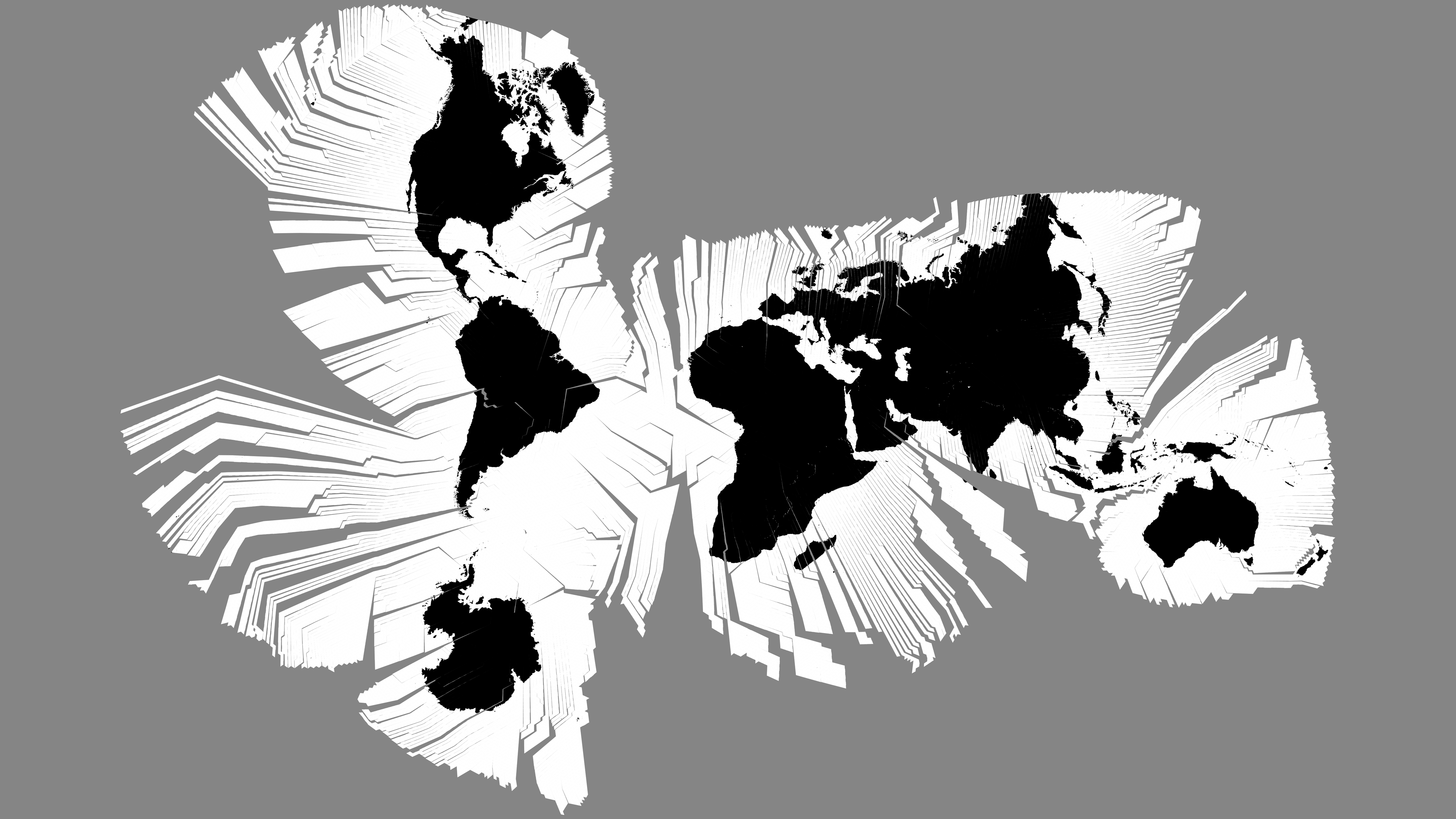
1228cae3fdcbdcb867952135e9eeaec7d894c092eb8dae828d0dd61ad8658fd7
See the bibliography for stable primary links,
the configuration evidence, data sources, and licensing notes.
The exact reconstruction inputs, generators, selected tree, planar baseline,
and scoring output are preserved in the
assets.static/myriahedral artifact
manifest.