Star-X bibliography and source provenance
Documentation index · Geometric context · Implementation notes
This bibliography separates the Star-X arrangement from the inherited Cahill-Keyes geometry, historical octahedral material, and repository test artifacts. Web resources were last checked on 2026-08-01.
Direct Star-X sources
-
De Kosnik, Benjamin. “Cahill Keyes Star-X.” sunglint, 2022-06-27. Project description and plate diagram.
This is the primary arrangement source. It describes cutting the four horizontal Cahill-Keyes sections into two groups, keeping the first two below, rotating the third and fourth sections above them around the North Pole, and using a
4 3 / 1 2plate order. It also records four 17-by-22 portrait components and the resulting 34-by-44 carrier. -
De Kosnik, Benjamin. “Star-X Internet Maps.” Portfolio entry, 2022–ongoing. Project overview.
This identifies Star-X as a vertically compact, North-Pole-centered redesign of the Cahill-Keyes Butterfly M map and records its rotational, tiling, and internet-geography context.
-
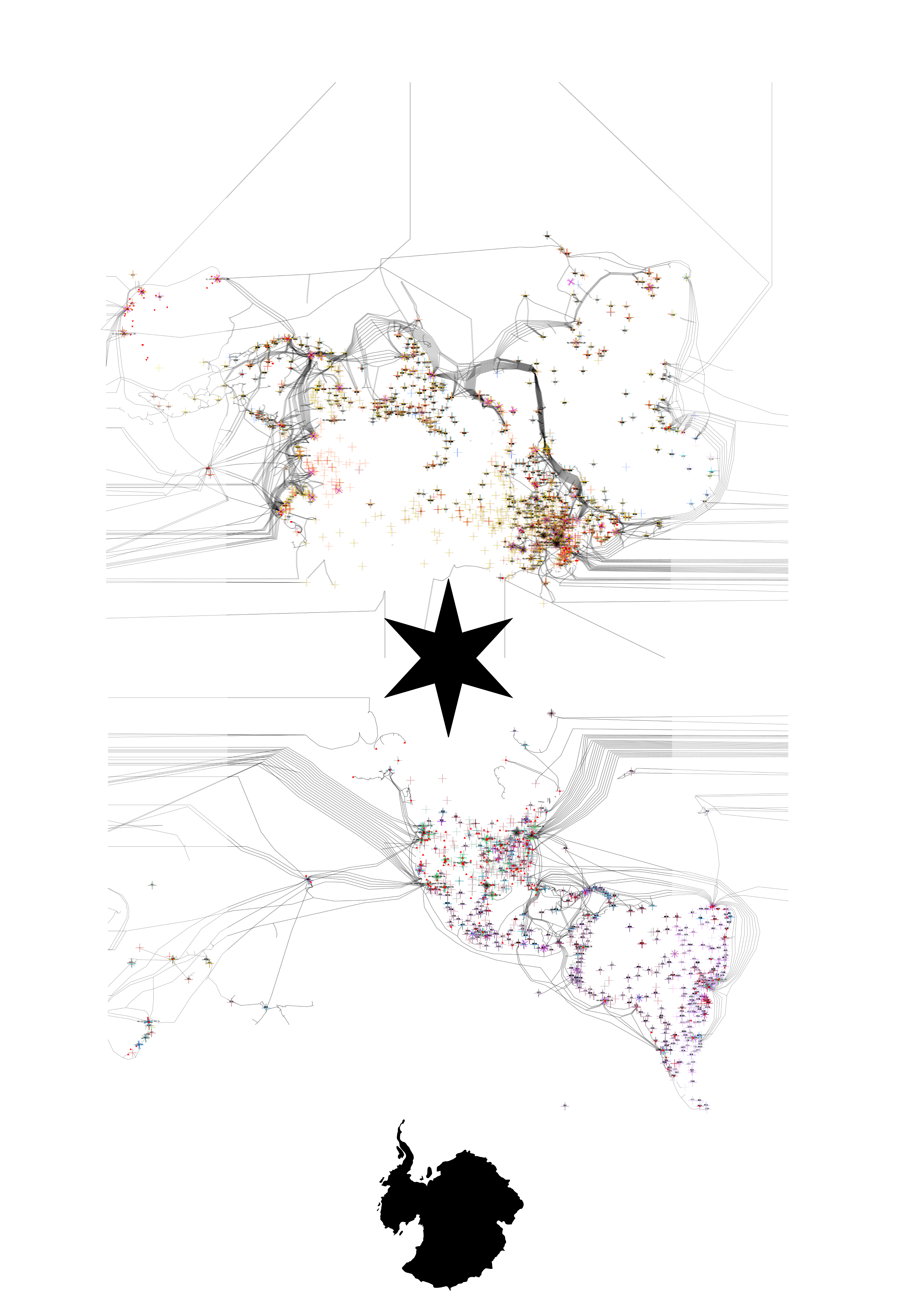
De Kosnik, Benjamin. Historical Star-X rendered composition, 2024. Repository image.
The image is used to illustrate orientation and visual context. Its data overlays, crops, and page decoration are not numeric projection inputs.
Inherited Cahill-Keyes implementation
-
Graça, Mary Jo, and Gene Keyes. “MegamapMaker-prep9.” Perl source, 2012-03-15, with later notes dated 2013-11-28. Repository copy.
This is the direct source of the half-octant A–L formulas, preliminary scaffold, geographic normalization, and ordinary M-layout used by both C++ projections. Its header contains the applicable attribution, non-commercial-use, modification, redistribution, and commercial-contact terms.
-
cartofreako contributors. Native C++20 Cahill-Keyes forward projection.
cart0freak0-cahill-keyes.h.Star-X calls this implementation directly. It is the numerical authority for local face geometry and the source M-layout; Star-X adds the group rearrangement, uniform page scale, and polar-composition helpers.
-
cartofreako contributors. Cahill-Keyes implementation notes and source map. Implementation documentation.
This gives the formulas, constants, scaling proof, raster registration, test provenance, and licensing detail intentionally not duplicated in the Star-X notes.
Octant numbering and geometric specifications
-
Keyes, Gene. “Around the World in 8 Easy Pieces: The Cahill-Keyes 1-Degree Globe.” 2013-09-19. All eight octants and polar assemblies.
The page labels individual octants and shows the four-octant North- and South-Pole assemblies. It is the visual reference for distinguishing official geographic octant numbers from left-to-right M-layout slots.
-
Keyes, Gene. “Cahill-Keyes Megamap Principles & Specifications.” CKOG principles.
This specifies the 10,000-unit octant scaffold, mirrored half-octants, meridian regimes, polar spacing, equisection, and supple zones inherited by Star-X.
-
Keyes, Gene. “Cahill-Keyes Octant Graticule and Grid.” 2011-01-12. Construction illustrations.
The diagrams connect longitude/latitude input, reference half-octant geometry, and final eight-face assembly.
-
Keyes, Gene. “Ongoing Development of the Cahill-Keyes Multi-Scale Megamap: Papers and Prototypes, 1973–2014.” Updated 2014-09-21. Development index.
-
Keyes, Gene. “Zooming to Crimea in the Cahill-Keyes Multi-Scale Megamap, Beta-2.” 2014-03-11. Beta-2 demonstration.
These two sources document the wider design history and scale-independent vector-map intent of the inherited projection.
Historical octahedral background
-
Cahill, Bernard J.S. “An Account of a New Land Map of the World.” Scottish Geographical Magazine, September 1909, pp. 449–469.
-
Cahill, Bernard J.S. “Map of the World.” U.S. Patent 1,054,276. Filed 1912-03-05; issued 1913-02-25. Patent text and drawings.
-
Cahill, Bernard J.S. “A Land Map of the World on a New Projection.” Journal of the Association of Engineering Societies, October 1913, pp. 153–207.
These establish the octahedral and Butterfly background. Star-X uses the later Cahill-Keyes geometry and De Kosnik arrangement; it is not a direct implementation of Cahill’s 1909 graticule.
Registration and repository verification
- Visionscarto. “Cahill-Keyes 44 × 22.” SVG map asset, 2018. Repository SVG.
This is the registration family whose one-degree longitude adjustment is shared by the Cahill-Keyes and Star-X public APIs.
-
cartofreako contributors. Star-X public API verification.
test-star-x-projection-api.cc. -
cartofreako contributors. Perl-derived Cahill-Keyes API anchors.
test-cahill-keyes-projection-api.cc. -
alpha60 contributors. Geographic integration anchors.
augment_carto_geo_specific.
The Star-X reference points apply its documented rigid transform and centered page scale to item 17. The test also compares both public projections across a separate global grid and checks every item 18 location.
-
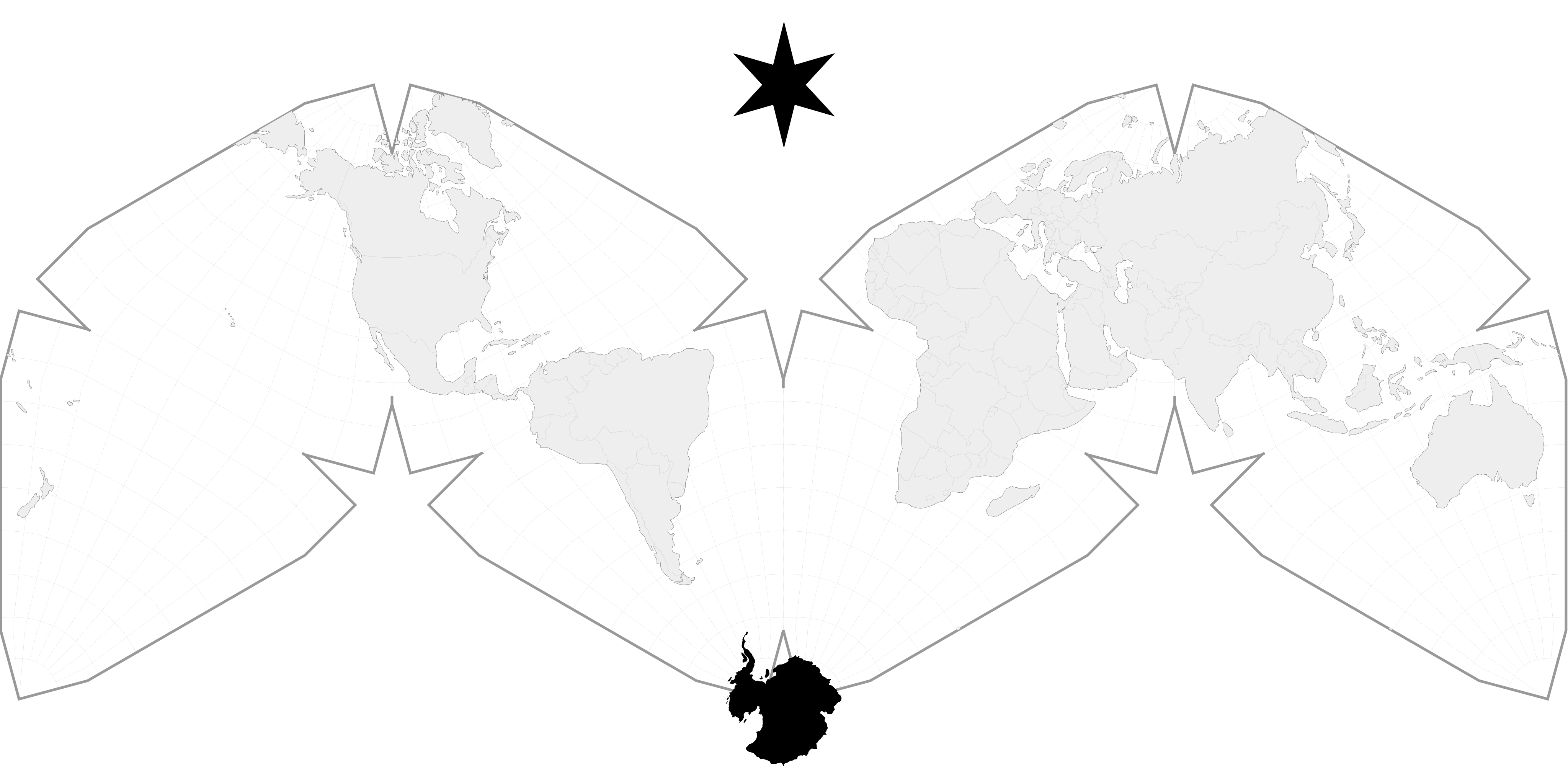
De Kosnik, Benjamin. “Geometry Star-X 34 × 44 with poles.” SVG concept drawing, 2026. Repository reference.
This illustrates the requested 120-percent page-centered scale, central star, and unified Antarctic presentation. Its Antarctica silhouette is intentionally not a scale or placement reference; the implementation uses the documented projection-relative radius, fixed
60°Sboundary, and projection-only lower-clearance registration instead. -
Natural Earth. “1:10m Physical Vectors.” Dataset page.
GDAL clips these physical source layers at the projection’s fixed
60°Sboundary. Natural Earth supplies geographic content only: it does not select the cutoff, radius, bearing, pole position, or lower clearance. The same cap can therefore be registered and drawn as a graticule without the dataset.

Source-to-implementation map
| Implementation concern | Principal source |
|---|---|
| Half-octant formulas and ordinary M assembly | MegamapMaker-prep9.pl and native C++ port |
Left/right split, 180-degree rotation, 4 3 / 1 2 ordering |
2022 Star-X project description and plate diagram |
| 17:22 variable carrier ratio | Historical 34-by-44 four-panel composition |
| Gap closure and 120-percent page scale | Requested Stage 4/5 geometry and repository concept drawing |
| North-pole star and unified Antarctica | Repository concept drawing for intent; analytic star, fixed 60°S cut, radius-preserving bearing transform, and projection-only 0.25/44 lower-clearance registration for final geometry |
| Official octant numbering | Keyes’s eight-octant and polar-assembly page |
| Longitude registration | Visionscarto asset family and shared C++ helper |
| Numeric compatibility | Perl-derived CK anchors and Star-X API test |
Documentation index · Geometric context · Implementation notes